


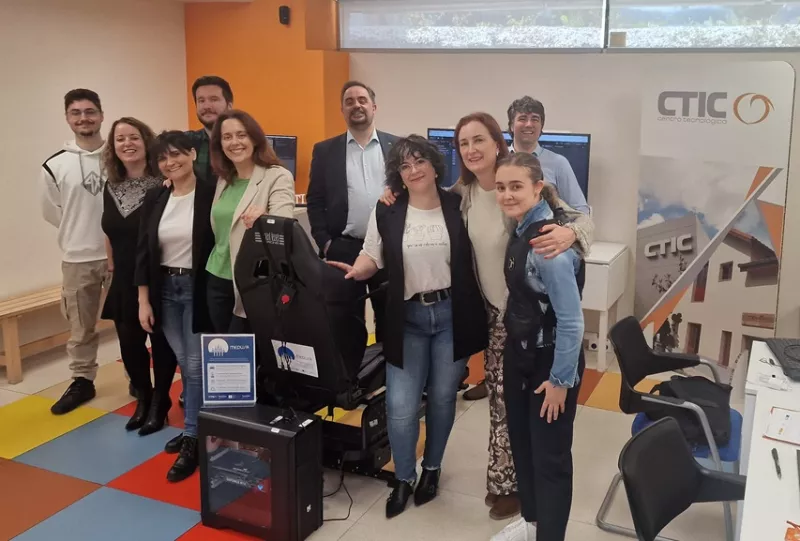
A cutting-edge technological demonstrator allows exploring how to design work environments that preserve and value the role of human work from an ethical perspective, consolidating CTIC as a reference centre in responsible artificial intelligence.
How do people interact with autonomous vehicles in critical contexts? Is it possible to remotely monitor and control these machines in a reliable way? What factors influence the operator's confidence and responsiveness?
These are some of the questions that will be addressed in the demonstration experiments that CTIC Technology Centre is carrying out from 20 to 22 May at its headquarters in the Gijón Science and Technology Park. For three days, this space is transformed into an advanced validation environment to experiment with new forms of remote operation of industrial autonomous vehicles (UGV) anticipating the jobs of the future in industry 5.0 and the ability to design work environments that protect the role of the worker from an ethical approach.
Jimena Pascual, Director of Organisational and Social Innovation at CTIC explains how ‘the approach of the tests is to see if the design we have made really corresponds to the needs that the employees of the future will have. Our idea, because of CTIC Technology Centre's ethics and commitment, is that technology cannot be a barrier, nor are we satisfied that the evolution of technology or artificial intelligence is going to leave people out. It is about making designs that incorporate the user from the beginning and thereby mitigate the transition to new industry to users 4.0 or users 5.0. In short, it will lead to improved employability, improved change management and improved adaptation of traditional jobs to the future.
The interaction between people and autonomous vehicles in critical contexts, as well as their remote monitoring and control, poses complex challenges that encompass technical, human and ethical dimensions. In order to analyse these aspects, an experiment is being carried out in which several people interact with an immersive interface developed by CTIC. This interface makes it possible to monitor and take control of an autonomous vehicle remotely, without the need for direct physical or visual contact with the machine.
The simulation of critical scenarios not only evaluates the technical efficiency of these advanced interfaces to set up a remote teleoperation station. It also focuses on how people perceive the interaction and the information they receive through the simulator - whether visual, auditory or sensory - with particular attention to aspects such as mental workload, confidence in making critical decisions and the level of control they experience during operation.