


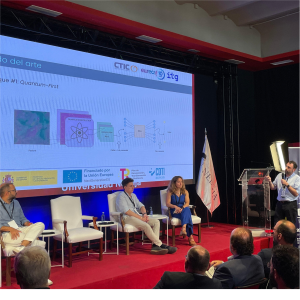
● During the event, three technology demonstrators have been shown that apply quantum computing to problems of classification of satellite images, optimization of energy distribution in an energy community and the detection of fraudulent signatures generated with generative AI.
The general secretary of Innovation of the Ministry of Science, Innovation and Universities, Teresa Riesgo, and the general director of CTIC, Pablo Coca, opened the conference, which was closed by the general director of the Center for Technological Development and Innovation (CDTI), José Moisés Martín Carretero.
Madrid, June 18, 2025.
The technology centers CTIC, Eurecat and ITG have presented today in Madrid the results of the last two years of joint work, within the framework of the Cervera ARQA Network of Excellence, which demonstrate the potential of quantum computing to solve complex tasks such as the analysis and classification of satellite images, the optimization of energy distribution and the generation of images to detect fraud.
"We aim to bring innovation and quantum technologies closer to companies because they will have a major impact in the medium and long term in many sectors," said Pablo Coca, general manager of CTIC, the technology center coordinating the ARQA network. "Initiatives like the ARQA Network, thanks to CDTI funding through the Cervera program, allow organizations like ours to work as a team to advance technologies, while allowing us to inform companies and society about the status and real potential of these technologies".
"From the Ministry of Science, Innovation and Universities, we are pleased to be able to participate in this technological development conference organized by the ARQA Network, a strategic opportunity for our companies to approach quantum computing and learn first-hand about its development in our country, as well as to collaborate with experts to develop innovative solutions and explore their application to real challenges. ARQA, as a Network of Excellence Cervera, is a key space in the promotion of innovation and technological development in quantum computing applications, to position our country at the forefront of these technologies," said the Secretary General of Innovation, Teresa Riesgo.
Today's event was also attended by the head of the Area of the Office for Digital Spain 2030 and Internationalization, Susana de Prado Hernandez, who presented the Spanish Strategy for Quantum Technologies, and the Director General of the Center for Technological Development and Innovation (CDTI), José Moisés Martín Carretero, who closed the event.
The analysis of satellite images using quantum technology to improve land management
The demonstrators developed by the ARQA Network allow companies to showcase the knowledge achieved in the field of quantum computing and the potential to offer real and transferable solutions in the medium term. One of the quantum demonstrators developed by the ARQA Network under the coordination of Eurecat focuses on the problem of satellite image classification.
On images of a dataset taken by the Sentinel 2 satellite, a tool has been developed to identify the elements present, such as rivers, forests, roads, lakes or cities, in order to classify them according to their contents.
With this demonstrator "we have explored the advantages of using three types of algorithms when making this classification: classical, simulated quantum and pure quantum computation," said the principal investigator of the Eurecat Quantum Computing Research Group, Adan Garriga. "The results obtained exemplify how quantum computing can be effectively applied to these types of problems," concluded Garriga.
Optimizing the use of renewable energies thanks to quantum computing
Another of ARQA's demonstrators, coordinated by the ITG technology center, is focused on improving the profitability of systems in energy communities, where
generation, loads and energy sharing are key to reducing costs and making the most of the renewable energy generated. Considering factors such as solar energy forecasting, the consumption of different users and electricity market prices, this technology has been tested in the concrete and real case of an energy community.
"By means of quantum algorithms of combinatorial optimization it is possible to identify the best way to distribute the energy from renewable generation within an energy community, increasing its profitability for all the users that are part of it", explained Óscar González, director of AI and ICT at ITG.
Specifically, the algorithms analyze and manage renewable energy distribution and resource allocation, obtain optimal charging and discharging times and flexible charging operations. "We have designed multiple scenarios based on data from the SmartGrids Laboratory of our advanced experimentation center, and we have been able to test how the quantum algorithms developed successfully solve this problem, taking those of discharging the battery at key times and activating the loads in the most advantageous schedule," said Óscar González.
Thus, the solution reduces energy costs, increases efficiency and reduces greenhouse gas emissions, showing the way to the energy market of the future.
Quantum technology applied to fraud detection in AI-generated images.
Another field where quantum computing can bring great benefits is that of Generative Artificial Intelligence. The third ARQA Network demonstrator applies quantum computing to a security risk that threatens banking, legal and administrative environments: the generation of handwritten signatures with
generative AI.
Under the coordination of CTIC, this demonstrator has explored the use of quantum adversarial generative networks (QGANs) to train a generative model, which learns to generate synthetic signatures, and a discriminative model, which learns to detect whether the signature is true or forged.
"The results show increasingly realistic synthetic signatures, and a quantum discriminant capable of differentiating well the background from the trace and giving appropriate feedback to the generator. The purely quantum model has given very good results, despite its complexity, demonstrating the potential of applying quantum computing in this area," explained Luis Meijueiro, leader of the CTIC quantum computing team.
The key role of technology centers and public funding in the quantum future.
The global market for quantum technologies is advancing rapidly, estimated to reach a global value of 152 billion euros by 2040. In this context, public investment in science and technology will make it possible to transform knowledge into real impact.
The Cervera ARQA Network of Excellence, coordinated by CTIC Technology Center together with Eurecat and ITG, is a strategic alliance that promotes R&D in quantum computing applications oriented to the business fabric, from process improvement to the development of new services.
Funded by the Ministry of Science, Innovation and Universities, through the CDTI, through the Cervera Technology Centers of Excellence 2023 program and the NextGenerationEU European funds, this initiative positions technology centers as drivers of innovation in the field of quantum computing, and ensures that Spain is at the forefront of the new quantum economy.
Today's event was held at the Princesa Campus of the University of Nebrija with the support of the Center for Technological Development and Innovation of the Ministry of Science, Innovation and Universities.
About CTIC
CTIC Technology Center is a leading technological innovation organization that promotes business competitiveness through the incorporation of information and communication technologies (ICT). Its purpose is to act as an engine of
innovation, working closely with companies, public administrations and the scientific field, promoting the territorial development and the digitization of processes. CTIC has a research line specialized in quantum computing since 2018 and collaborates since then with the QHPC (Quantum and High Performance Computing) group at the University of Oviedo. Its infrastructures include ISAAC: a supercomputer capable of simulating quantum experiments of up to 38 qubits and the QUTE quantum simulation platform. CTIC thus consolidates its role as a reference in research and application of quantum computing, combining advanced infrastructure, scientific collaboration and commitment to technological development. More information at https://ctic.es
About Eurecat
Eurecat is one of the most important applied research and technology transfer organizations in southern Europe. It brings together the experience of more than800 professionals who generate a volume of income that exceeds 69 million euros annually and provides services to more than 3,200 companies. Applied R&D, technological services, highly specialized training, technological consultancy and exploitation of industrial property are some of the services that Eurecat offers to both large and small and medium-sized companies in all sectors. It participates in more than 200 large national and international R&D&I consortia projects of high strategic value and has more than 230 patents and 10 spin-offs. The added value provided by Eurecat accelerates innovation, reduces spending on scientific and technological infrastructures, reduces risks and provides specialized knowledge tailored to each company. More information at www.eurecat.org
About ITG
ITG (A Coruña, 1991) is an officially recognized National Technology Center, specialized in providing R&D and differential technology to improve the competitive capacity of companies and organizations. It develops solutions in the field of industry 4.0, intelligent management of energy, digitalization of water and unmanned aerial mobility. It is a center of Cervera research excellence in AI and quantum computing; one of the five certifying bodies in the world for the BREEAM® international seal of sustainable construction; and the first official partner in Spain for the WELL™ international seal of health in buildings.
It has been a member of the governing council of the Spanish Federation of Technology Centers (FEDIT) since 2010, and its general manager assumed the presidencyof the 47 associated technology centers from 2015 to 2022.
.