


CTIC develops a digital twin in the Aran Valley from the data collected by GPS collars installed on sheep and advises on the implementation of virtual fencing.
The visit is part of the OVIHUEC.DAT project and took place between June 2nd and 5th.
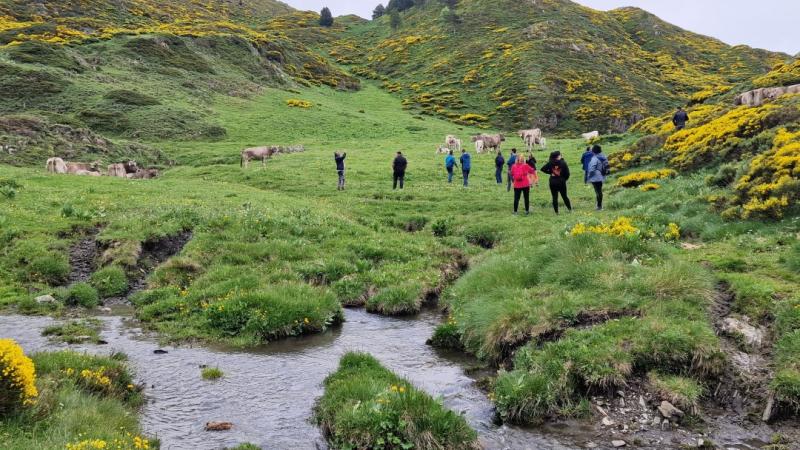
A delegation composed of twelve livestock farmers from Valle de Lago (Somiedo) and technical staff from CTIC Technology Centre visited the Aran Valley this week as part of the OVIHUEC.DAT project, an initiative focused on studying the socio-economic and environmental impact of communal grazing in rural areas.
The visit is part of an exchange program between pastoral communities aimed at sharing experiences, best practices, and innovative solutions. This second meeting follows the visit made last October by livestock farmers and institutional representatives from the Aran Valley to Somiedo, where they experienced firsthand the traditional practices and technologies applied by CTIC in livestock management. During their stay in the Aran Valley, the delegation was welcomed at the headquarters of the Conselh Generau d’Aran (Vielha) by Maria Vergés, Síndica of Aran, and Oriol Sala, Second Vice-Síndic and Mayor of Vilamòs.

The livestock farmers from Somiedo explored the functioning of communal grazing groups in areas such as Vilamòs and the Barradòs Valley, and participated in working sessions with local shepherds and technicians. These activities promoted knowledge exchange and the identification of common challenges in land management, animal welfare, and landscape conservation.

Technology transfer: virtual fencing and digital twin
One of the highlights was the analysis of technology transfer promoted by CTIC, which is leading the adaptation of digital tools successfully developed in Somiedo—such as virtual fencing and the digital twin—to the context of the Aran Valley. CTIC has advised on the implementation of virtual fencing—a technology that delineates grazing areas without physical barriers—and is developing a digital twin based on data collected through GPS collars installed on the sheep. This tool allows intelligent livestock monitoring and supports decision-making for more efficient and sustainable pastoral management.

The meeting reinforces CTIC’s role as a knowledge catalyst between rural mountain territories and marks a key step in connecting local experiences with advanced digital tools. The shared goal among all involved actors is clear: to promote sustainable, efficient, and extensive livestock farming adapted to the challenges of today’s rural environment, integrating respect for the land with responsible use of technology.
The OVIHUEC.DAT project thus consolidates itself as a space for collaboration and innovation among livestock farmers, technicians, and institutions, with communal grazing as the backbone of a resilient and connected rural development model.

OVIHUEC.DAT
OVIHUEC.DAT is supported by the Biodiversity Foundation of the Ministry for the Ecological Transition and the Demographic Challenge (MITECO), within the framework of the Recovery, Transformation and Resilience Plan (PRTR), funded by the European Union – NextGenerationEU.
OVIHUEC.DAT is coordinated by the Institute of Agrifood Research and Technology (IRTA) and includes participation from several entities, including CTIC (Information and Communication Technology Centre), the Food and Agricultural Development Research Centre - UPCIRTA (CREDA), the Vilamòs Town Council, the Conselh Generau d’Aran, and the Forest Science and Technology Centre of Catalonia (CTFC).